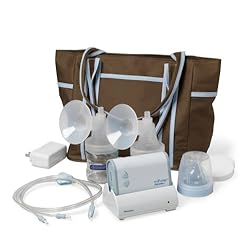
Image from pumpease.com
It's not easy being a working mother today in the United States. Workplaces often value economics and individual accomplishment more than they do the worker and what makes them well and happy. It's simply about the bottom-line, profit. Of course these same workplaces seem to ignore the data that concludes having a mother-friendly workplace actually helps their profit. I suppose that given our culture of individual success as the utmost accomplishment it's hard to believe that by providing workplace mother-friendly provisions we would actually benefit economically.
There are a variety of options employers can use to make their workplace more mother-friendly:1. Allowing moms to bring their babies to work
2. On-Site Daycare
3. Having a nursing and pumping lounge and creating an atmosphere where mothers feel
comfortable pumping
4. Offering paid maternity and paternity leave
Some of these are more revolutionary than others and some cost more than others. Let's do a bit of imagining. What if every workplace simply offered an on-site daycare? How would that change the face of mothering? No worrying about extraordinary daycare costs, if you breastfeed you would be able to use lunches and breaks to nurse instead of pump and if you don't breastfeed then you'd be able to use that time to hold your baby and feed them as well. Moms wouldn't have to worry they were jeopardizing their relationship with their family by returning to work. Employers would benefit by having parents who are more committed to their workplace and have to take off less time because their child is within walking distance. It's a beautiful scenario. It would also create more jobs which, especially in this economy, is always a fantastic benefit. I understand that it comes at an initial cost to the employer and that is why we need to advocate for the government to subsidize the creation of the daycare and give tax breaks that help offset the cost of hiring the daycare provider. Of course if you continue reading below you will see that providing these benefits already provides an employer with a return on their investment.
We have reached a fantastic milestone but still have a long road ahead of us. Within the new federal health bill is a provision that allows mother's who work in places that employ more than 50 people to pump at work so long as their child is one year old or younger. These places must provide pumping breaks and a place for moms to pump: "Employers are required to provide “reasonable break time for an employee to express breast milk for her nursing child for 1 year after the child’s birth each time such employee has need to express the milk.” Employers are also required to provide “a place, other than a bathroom, that is shielded from view and free from intrusion from coworkers and the public, which may be used by an employee to express breast milk.”" To read more visit the following website:
Fact Sheet - Break Time for Nursing Mothers and the following website:
Health Care Reform Boosts Support for Employed Breastfeeding Mothers.
The United States Breastfeeding Committee also put out a paper that outlines how and why allowing lactation breaks in the workplace is needed and beneficial to the business:
Workplace Accommodations to Support and Protect Breastfeeding.
I realize that previously I said something about how employers actually get a return on their investment and save money when adopting mother-friendly policies. I'm sure some of you are questioning the validity of this especially if you are business owners or managers yourselves. So I want to provide you with more information on that matter. According to
Babies in the Workplace bringing a baby to work offers several benefits: earlier return to work, increased employee retention, increased morale, enhanced teamwork, attraction of new employees, lower health costs, increased overall productivity, attraction of new customers, higher customer loyalty, and low implementation costs. See the website linked above for data on each of these benefits. In addition to those benefits research has shown that businesses do get an economic return on this investment of providing accommodations for nursing mothers. According to The United States Breastfeeding Committee, backed by research, at the level of basic accommodation for a one dollar investment the business gains a two dollar return. However, at the level of comprehensive accommodation for a one dollar investment the business gains a three dollar return. This is a pretty substantial financial return. Here is a brochure that outlines how businesses benefit from having such accommodations:
The Business Case for Breastfeeding.

What we can do:
1. Write Senator Merkley of Oregon and thank him for putting the new federal pumping guidelines in the Health bill. Express your desire to see more mother friendly laws put into place.
2. Write your own Senator and provide him with information from the links in this article. Tell him how as his constituent you want to see him support mother friendly laws.
3. Provide the company you work for, or a mother friend works for, with the brochure linked above.
4. Start a mother's-at-work group in your area and discuss ways you can advocate for change.
Useful Link: Contact Your Senator Information OnlineIf you have more ideas on how we can create change in this area please let me know in the comments section.On a personal level I faced the decision myself: go back to work and pump leaving my twelve week old baby in the arms of another or stay at home and be financially destitute but be her primary care provider and have no possibility of jeopardizing our nursing relationship. It was both the most difficult and easiest decision I ever made. I'm now a stay at home mom thanks to my wonderful husband who works like crazy to keep our heads mostly above water. Also thanks to government programs like WIC that help mothers who are low-income. I don't like relying on government help but I'm willing to sacrifice my comfort to give my child what I feel is the best. Before quitting my job however I gave them an option, let me bring my baby to work. I worked in a community room that was equipped with a television, couch, kitchen, and computer lab. It was the perfect area to allow a more progressive approach for the working mother. My request was denied and I gave up my health insurance to stay home with my daughter, unable to get more because of pre-existing conditions. If I would have chosen to work my entire paycheck, save about sixty dollars, would have went to paying for daycare costs. It simply wasn't worth it. So although now we are living at the poverty level I can rest at night because I am able to give my daughter unquestionably the best care available, that of her mother. I hope that my own daughter is never put in this position.